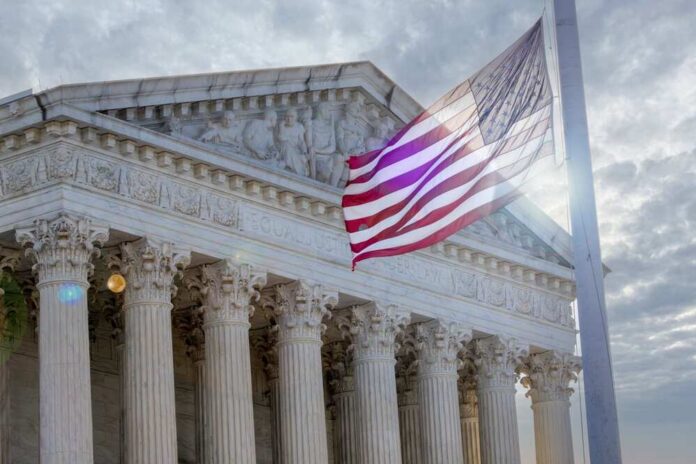
When the Supreme Court upheld birthright citizenship and struck down Trump’s limits, Justice Clarence Thomas fired back with a 91-page warning that the Court is rewriting the Constitution to serve political power, not the people.
Story Snapshot
- Supreme Court rejects Trump’s order limiting birthright citizenship and keeps the 14th Amendment rule in place.
- Justice Clarence Thomas’s blistering dissent says the majority is “not historically accurate” and devalues American citizenship.
- Thomas argues citizenship belongs only to babies of parents who are truly settled, not birth tourists or illegal border crossers.
- The fight exposes deep anger on both left and right over elites twisting old laws to fit today’s politics.
Supreme Court Strikes Down Trump’s Birthright Citizenship Order
The Supreme Court has struck down President Donald Trump’s executive order that tried to deny citizenship to certain children born in the United States. The order would have blocked babies from becoming citizens if their parents were in the country illegally or only here for a short time, such as on student or work visas. For more than a century, the rule has been simple: almost every child born on American soil is a citizen, with only narrow exceptions like children of foreign diplomats. By rejecting Trump’s order, the Court left that basic rule in place and delivered what many call the biggest legal loss of his second term.
The case, known as Trump v. Barbara, grew out of a long fight over the meaning of the Citizenship Clause of the 14th Amendment. That clause says “all persons born or naturalized in the United States, and subject to the jurisdiction thereof” are citizens. Trump’s team argued that “subject to the jurisdiction” does not cover babies whose parents are here only briefly or against immigration law. Immigrant-rights groups, backed by more than a century of court decisions, answered that the Constitution promises citizenship to almost everyone born here, no matter their parents’ status. Lower courts repeatedly blocked Trump’s order as clearly unconstitutional before the Supreme Court finally ruled on the core question.
Thomas’s “Nuclear” Dissent: Citizenship and Domicile
Justice Clarence Thomas, joined by Justice Neil Gorsuch, filed a 91-page dissent that sharply attacked the majority’s reading of the Constitution. Thomas argues that both the Civil Rights Act of 1866 and the Citizenship Clause guaranteed citizenship only to people born and domiciled in the United States, meaning their families are truly settled here. In his view, neither law ever promised citizenship to children whose parents are mere visitors, tourists, or illegal border crossers. He wrote that many uses of Trump’s executive order would match the “original public meaning” of the Citizenship Clause, even if the majority refused to see it that way.
Thomas claims the Chief Justice’s opinion is “not historically accurate” about what the Reconstruction Congress meant when it wrote the 14th Amendment. He stresses that the clause was created to secure equal rights and citizenship for freed Black people after the evil of Dred Scott, not to settle modern immigration disputes. In his dissent, he warns that this promise has been “repurposed for political projects that the Reconstruction Congress did not support,” suggesting today’s leaders stretch old language for new agendas. This criticism touches a raw nerve for many Americans who believe both parties twist laws to stay in power while ordinary people pay the price.
Birth Tourists, Illegal Immigration, and Fears of Devalued Citizenship
Thomas’s harshest language targets what he calls “birth tourism” and illegal immigration. He says today’s ruling “devalues” American citizenship by creating a constitutional right to citizenship for the children of all foreign birth tourists and illegal aliens. For millions of conservatives, this lines up with long-running anger over illegal immigration and the sense that elites care more about global flows of people than about the struggles of citizens who follow the rules. Thomas argues that true allegiance grows from lawful domicile, not from a quick trip over the border or a short stay on a visa.
At the same time, many liberals see Trump’s order and Thomas’s dissent as part of a wider pattern of targeting immigrants and weakening equal protection. Civil rights groups point out that courts have long treated birthright citizenship as a core promise of American fairness, especially for people who do not have wealth or political power. They argue that pulling citizenship from babies born here would split families, deepen the gap between the “haves” and “have-nots,” and give the federal government scary new power over who truly belongs. In this light, both sides share a deeper fear: that Washington can change something as basic as citizenship for political gain.
Long-Standing Precedent and the Limits of Thomas’s Argument
Thomas’s dissent faces a major roadblock in Supreme Court history: the 1898 case United States v. Wong Kim Ark. In that case, the Court held that a child born in San Francisco to Chinese parents who were not citizens was still a citizen because he was born on American soil. The Court relied on the old “right of the soil” rule and said that place of birth fixed citizenship, except for very narrow groups like foreign diplomats or invading armies. Trump’s order, and Thomas’s focus on domicile, clash directly with this settled precedent that has guided courts and presidents for more than 120 years.
Critics note that the text of the 14th Amendment does not mention “domicile” at all, so Thomas must rely on history and implied meaning to add that requirement. Legal briefs filed against Trump’s order say Congress and the framers knew the clause would cover children of noncitizens, including those who might not intend to stay forever. Major legal groups argue that the record shows broad support for birthright citizenship and no clear effort to carve out temporary visitors or illegal immigrants. This gap between Thomas’s reading and the written text fuels worries that judges are now picking and choosing history to fit today’s politics.
Public Opinion, Media Spin, and Deep Distrust of Elites
Polls show that more than seventy percent of Americans support birthright citizenship, which makes Thomas’s position a tough sell outside some conservative circles. National media outlets quickly framed his dissent as “scathing” and “nuclear,” often focusing on the political drama instead of the legal details. Some commentators even tried to link his arguments to “white supremacist views,” turning a complex debate over history and text into another culture-war shouting match. Such coverage reinforces the feeling on both right and left that the information gatekeepers would rather inflame people than explain what is really at stake.
In his dissent (joined by Justice Neil Gorsuch), Justice Clarence Thomas argued that the 14th Amendment’s Citizenship Clause was enacted primarily to secure citizenship for formerly enslaved Black Americans in the wake of Dred Scott v. Sandford, which had denied citizenship to… pic.twitter.com/3PIraoeJzF
— Official_ByzQueen (@ByzQueen) June 30, 2026
At the same time, many legal experts say that any serious change to birthright citizenship would likely require a constitutional amendment, not just a new executive order or court ruling. That means the basic rule remains safe for now, even as fights over meaning continue. For ordinary Americans watching from the sidelines, this case is another example of powerful players using century-old words to wage modern battles, while the deeper problems—wage stagnation, high costs, broken immigration systems, and fading trust in government—go unresolved. Thomas’s dissent does not change the law today, but it shows how divided even the highest court has become over what it means to be an American citizen.
Sources:
[1] Web – Clarence Thomas Goes Nuclear on SCOTUS Majority Over Birthright …
[2] X – Justice Clarence Thomas pens a scathing dissent after the Supreme …
[3] Web – Supreme Court strikes down Trump’s birthright citizenship executive …
[5] Web – [PDF] Defining “American”: Birthright Citizenship and the Original …
[6] Web – Birthright Citizenship Under the U.S. Constitution
[7] Web – 5 Observations On The Supreme Court Argument In The Birthright …
[9] Web – Supreme Court Arguments Wrap in Landmark Challenge to Trump …
[12] Web – Trump v. Barbara | Oyez
[15] Web – 8 FAM 102.3 SUPREME COURT DECISIONS – Foreign Affairs Manual
[16] Web – Supreme Court Expresses Skepticism at Trump’s Effort to Eliminate …
[19] Web – Trump’s attack on birthright citizenship is unconstitutional – …
[20] YouTube – Birthright citizenship arguments at Supreme Court