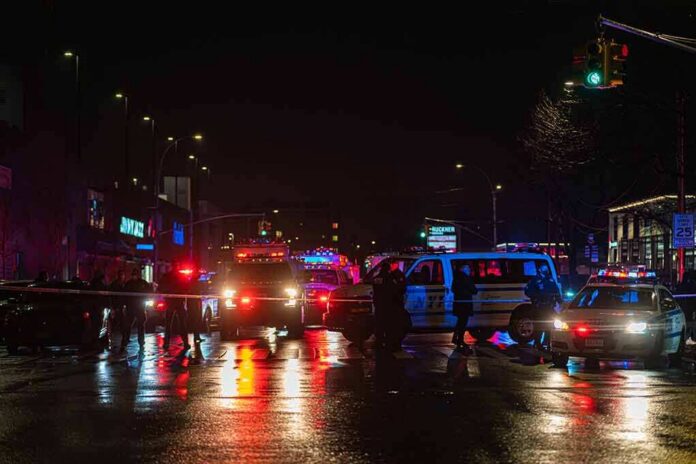
Newly released police body-camera video shows New York officers shooting a knife-wielding suspect in Times Square after she stabbed two people and threatened to kill the officers, underscoring a public-safety flashpoint in one of America’s busiest places.
Story Highlights
- Police say Pamela Cisneros stabbed two people near Times Square; one victim died.
- Bodycam video shows a standoff, failed stun gun use, and officers firing as she advanced.
- Commissioner Jessica Tisch says two knives were recovered and threats were recorded.
- Experts say such cases hinge on imminence, distance, and options used before shots.
What Police Say Happened in Times Square
New York Police Department officials say the attack began around 4:24 p.m. near West 41st Street and Seventh Avenue, steps from Times Square. They identified the suspect as 49-year-old Pamela Cisneros of Queens. Police say she stabbed two people in a random and unprovoked assault. One victim, a 32-year-old woman, later died at a hospital. The second victim survived. Officers confronted Cisneros soon after and found her holding two knives, according to police briefings and reports.
Police Commissioner Jessica Tisch said two knives were recovered at the scene and that the area was packed with bystanders. She described the setting as an extraordinarily dangerous situation in the heart of Times Square. Police say officers ordered Cisneros to drop the knives many times. Officials say she refused and made direct threats to kill the officers. Reporters quoted Tisch saying Cisneros repeated, “I will kill you,” when told to disarm.
Body-Camera Release and the Use-of-Force Sequence
The New York Police Department released body-worn camera video showing the encounter that ended in the shooting. The footage documents several minutes of commands to drop the knives, followed by a stun gun attempt that did not stop Cisneros. Officials say she then moved toward officers still holding the blades. Two officers fired their service weapons, striking her. She was later pronounced dead at a hospital, according to the released accounts and video summaries.
Published reports describe a tight sequence under crowd pressure. Police say the stabbings happened within seconds of each other before officers arrived. Once on scene, officers tried to contain the threat and create space. When the stun device failed and Cisneros advanced, the officers fired. Those steps match common training that weighs threat distance, weapon type, and failed less-lethal options before lethal force is used, according to legal and policing analyses.
Victims, Identities, and Community Impact
News outlets identified the woman who died as a Bank of America vice president, highlighting the human cost of sudden street violence in a tourist hub. Her death drew broad sympathy and renewed concern about random attacks in crowded places. The second victim, a man, received treatment for his wounds. The attack disrupted a dense pedestrian area, raised alarms for visitors and workers, and prompted calls for clarity on how police manage edged-weapon threats in tight spaces.
Police Bodycam Footage Shows NYPD Officers Fatally Shooting Knife-Wielding Woman Who Stabbed Two People in Times Square (VIDEO)
— 👑Helen Casey👑 (@HelenCasey1970) September 26, 2026
Commissioner Tisch and New York City officials defended the officers’ actions as consistent with training and necessary to stop an ongoing threat. Reporting notes that officers tried persuasion and a stun device before firing. Some outside experts have also said the decision to use deadly force could be justified, while stressing the risks of firing in a crowd. That mix of views often appears in knife cases where every foot of distance and second of reaction time matter.
Why This Case Resonates Beyond New York
This case fits a wider pattern that courts and use-of-force experts examine. The key question is often whether the threat was immediate at the moment shots were fired, not only whether the person was dangerous in general. Analysts point to factors like the suspect’s weapons, their movement toward officers, the failure of less-lethal options, and bystander risk. That framework helps explain why officials emphasize the warnings, the stun gun use, and the suspect’s advance with two knives.
The rapid release of body-camera footage also speaks to a growing push for transparency after critical incidents. While departments often shape the first narrative by choosing what to release and when, early video can give the public key facts quickly. In this case, the footage shows the standoff and the moment officers fired. Standard reviews will follow, as is routine after police shootings in New York, but the core timeline presented by police and media remains consistent at this stage.
What to Watch Next
Officials typically conduct internal reviews and collect evidence, including dispatch logs and interviews. Independent analyses may also look at distance, angles, and lines of fire in a crowded area. For now, the public record shows a fast, deadly attack, a tense standoff, failed less-lethal force, and officers firing as an armed suspect moved toward them. In a city where millions pass through tight spaces daily, that chain of events lands with special weight.
Sources:
bbc.com, 6abc.com, abc7ny.com, theguardian.com, us.headtopics.com, aljazeera.com, newser.com, ground.news