Iran tried to squeeze the world’s energy lifeline—and Washington responded by putting U.S.-flagged ships back through the Strait of Hormuz under armed protection.
Quick Take
- The Pentagon says “Project Freedom” is a defensive, temporary mission to reopen commercial shipping lanes after Iran’s blockade and harassment campaign.
- Officials separated Project Freedom from the broader war effort, describing it as focused on escorts, surveillance, and deterring attacks—not strikes on Iranian territory.
- U.S. leaders reported two U.S.-flagged commercial ships transited the strait with U.S. Navy support as the ceasefire remains fragile.
- Recent clashes included U.S. forces sinking six Iranian small boats amid drones, missiles, and attempted harassment, highlighting escalation risk even under a ceasefire.
Project Freedom aims to break a chokepoint blockade without widening the war
Secretary of War Pete Hegseth and Joint Chiefs Chairman Gen. Dan Caine used a May 5, 2026 Pentagon briefing to describe Project Freedom as a targeted maritime operation: keep commercial traffic moving through the Strait of Hormuz while deterring Iranian interference. Officials framed the effort as separate from the wider U.S.-Iran conflict and said it is designed to be defensive, limited in scope, and focused on protecting vessels in international waters.
U.S. officials said the immediate goal is restoring predictable shipping after Iran’s closure of the strait early in the war and what the Pentagon described as harassment tactics, including drones, missiles, and small-boat swarms. The briefing emphasized constant surveillance and a ready posture—warships, aircraft, drones, and tracking—intended to prevent Iran from imposing an “extortionist” tolling system. That framing matters because it anchors the mission in freedom of navigation rather than regime-change ambitions.
Why the Strait of Hormuz still drives American pocketbook politics
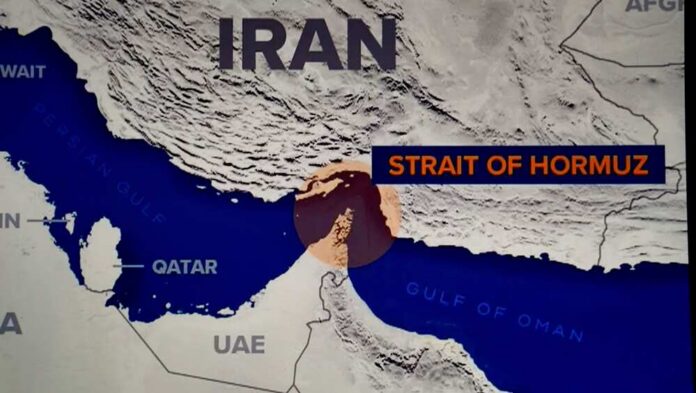
The Strait of Hormuz is a narrow maritime chokepoint linking the Persian Gulf with global sea lanes, and roughly one-fifth of the world’s oil flows through it. When Iran shut it down at the start of the war, fuel prices spiked worldwide, quickly turning a faraway naval standoff into a kitchen-table issue. For U.S. voters already fed up with inflation and high energy costs, the strait’s status becomes a real-world test of whether government can protect economic stability.
Project Freedom’s early headline claim—two U.S.-flagged commercial ships making safe passage with U.S. Navy support—signals the administration wants markets and adversaries to see American control of the sea lanes as credible. The conservative takeaway is straightforward: a functioning economy depends on secure trade routes, and energy affordability is not an abstract climate debate when geopolitical rivals can weaponize supply lines. The liberal critique—fear of escalation—also has a point, because choke points invite miscalculation.
A ceasefire can exist on paper while shots are still being exchanged
Pentagon messaging stressed that a ceasefire remains in place, even as officials acknowledged hostile actions at sea and in the region. Reporting around the operation described exchanges that included attacks involving missiles, drones, and small boats, plus U.S. forces sinking six Iranian boats during confrontations tied to the effort to reopen the strait. That gap between “ceasefire holds” and “contact continues” is the central complication: enforcement operations can reduce coercion while still creating opportunities for rapid escalation.
Deterrence, oversight, and the trust gap at home
President Trump’s administration presented Project Freedom as a clear, bounded response to a specific problem: Iran’s attempt to blockade and monetize international waterways. Yet Americans across the political spectrum remain skeptical of Washington’s ability to define limits and stick to them, especially after decades of open-ended conflicts and budget blowouts. Congress may back the operation in principle, but voters will judge it on transparent objectives, measurable results, and whether it prevents price shocks without sliding into another long war.
Hegseth, Caine Detail How We're Removing Iran's Last Desperate Play With 'Project Freedom'https://t.co/PmOL0z6a9W
— RedState (@RedState) May 5, 2026
The most grounded conclusion from the available reporting is also the simplest: protecting commercial transit is materially different from expanding the war, but the distinction must be proven in actions, not slogans. If Project Freedom continues to avoid Iranian territory while keeping shipping moving, it supports a limited-government argument for using force narrowly to defend national interests. If the mission drifts—unclear benchmarks, ambiguous rules, or blurred authorities—the public’s “deep state” suspicions will only grow.
Sources:
locked-and-loaded-us-deploys-warships-jets-to-counter-iran-in-strait-of-hormuz
pete-hegseth-dan-caine-iran-war-update-strait-of-hormuz-pentagon
pentagon-pete-insists-ceasefire-holds-as-shots-fired