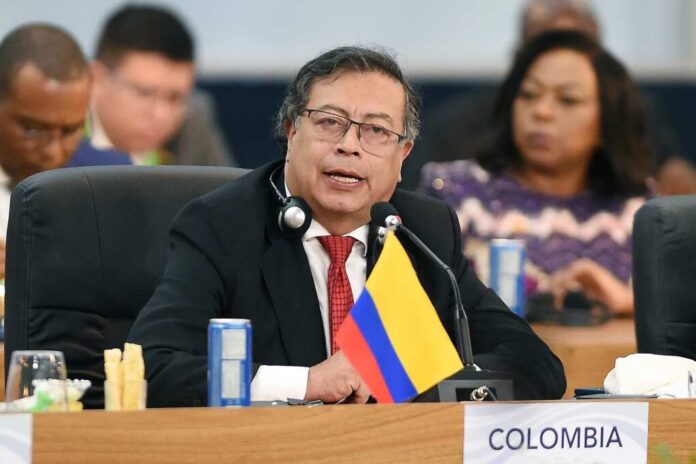
A new diplomatic confrontation has erupted between the United States and Colombia after President Donald Trump issued a stern warning to Colombian President Gustavo Petro, claiming he “will be next” if his government does not curb the rampant cocaine trade. This bold accusation, which labeled Colombia a “cocaine factory,” has sparked a heated international exchange, with President Petro quickly rebutting the claims as “misinformed” and detailing extensive, U.S.-supported anti-narcotics operations. The high-stakes exchange not only escalates tensions between the two nations but also underscores a strategic divergence in drug policy that carries significant implications for U.S.–Latin America relations.
Story Highlights
- Trump’s warning to Petro has sparked a diplomatic standoff, with accusations of misinformation.
- Petro’s response highlights Colombia’s extensive anti-narcotics operations.
- The exchange underscores tensions between U.S. hard-line drug policies and Colombia’s reformist approach.
- Regional implications loom large, with potential shifts in U.S.–Latin America relations.
Trump’s Bold Warning to Colombia
In a move that has sent shockwaves through international diplomatic channels, President Donald Trump warned Colombian President Gustavo Petro that he “will be next” if his government does not address the rampant cocaine trade. Trump accused Petro of allowing Colombia to become a hub for cocaine production, calling them “cocaine factories” that ship drugs directly to the United States. This stern warning has escalated tensions between the two nations, as Petro firmly rebuts these claims.
Petro quickly issued a statement on X (formerly Twitter), denouncing Trump’s rhetoric as “misinformed” and “disrespectful” towards Colombia’s democratically elected leadership. He detailed the country’s extensive operations against drug cartels, including over 1,446 ground operations and 13 bombings targeting criminal organizations, many of which are conducted with U.S. intelligence support.
‘Trump is very misinformed about Colombia’ – Petro after US president warns 'you're next!' pic.twitter.com/ogxoLNO7C0
— Viory Video (@vioryvideo) December 11, 2025
Colombia’s Strategic Response
President Petro’s response not only rejects Trump’s allegations but also highlights Colombia’s proactive stance in combatting drug trafficking. He emphasized that the geography of cocaine trafficking has shifted from the Caribbean to the Pacific Ocean and Amazon Basin, requiring new forms of cooperation, such as increased port controls and maritime monitoring. Petro’s government is working on developing faster surveillance vessels in Colombian shipyards with U.S. assistance to tackle the evolving threats.
Petro also warned against viewing Venezuela as merely a narcotics threat, arguing that the real issue lies in its democratic deficit. He cautioned that any U.S.-led military intervention in Venezuela could destabilize the entire South American region, including Colombia.
Implications for U.S.–Latin America Relations
The exchange between Trump and Petro highlights a strategic divergence in drug policy: the U.S. favors a kinetic approach with interdictions and strikes, whereas Petro supports development-led reforms. This clash could have broader implications for U.S.–Latin American relations, potentially prompting regional governments to rally behind Colombia if they perceive unjust targeting by Washington.
However, if Trump effectively leverages economic and security tools, some Latin American countries might distance themselves from Petro’s approach to avoid similar confrontations. The ongoing debate over drug policy underscores the need for a balanced strategy that addresses both security concerns and developmental needs in the region.
Watch the report: “You’ll Be Next”: Trump Warns Colombia’s Petro Over Cocaine Crisis | APT
Sources:
- Colombia’s Petro pushes back after Trump warns he ‘will be next’
- TRT World – Petro fires back at Trump, accuses US president of spreading misinformation on Colombia’s drug war
- Colombia’s Leader Says Trump Acts on “Complete Misinformation”