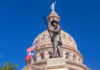
As President Trump opens the Theodore Roosevelt Presidential Library using a foreign-funded Air Force One, many Americans see another sign that history, politics, and elite power are colliding in ways that leave ordinary people on the sidelines.
Story Snapshot
- President Trump travels to Medora, North Dakota, to dedicate the new Theodore Roosevelt Presidential Library.
- The event is tied to the nation’s 250th anniversary, blending history with Trump-era politics.
- The trip marks the first use of a new Air Force One jet reported as a gift from Qatar, raising questions about foreign influence.
- The library’s opening highlights long-running concerns that powerful insiders shape how history is told and remembered.
Trump’s High-Profile Role in the Library Dedication
Freedom 250 organizers and the North Dakota state government both announced that President Donald J. Trump would join them on July 1, 2026, for the dedication of the Theodore Roosevelt Presidential Library in Medora, North Dakota. The event is described as part of the nation’s 250th anniversary celebration and is meant to honor the life and legacy of President Theodore Roosevelt, the 26th president known for his focus on the American West and conservation. Media outlets report that Trump is scheduled to tour the library and deliver formal remarks during the ceremony.
Video streams and local media posts show Trump’s arrival in North Dakota for the dedication, including live coverage of him traveling to and reaching Medora. A local television station’s social media update confirms that Trump is joining Freedom 250 for the dedication, citing event representatives who highlight his presence as a major draw. These visual records support the official announcements and make clear that the dedication is not just a quiet historical ceremony, but a national-level political moment with Trump at its center.
America’s 250th Anniversary and the Politics of History
Organizers link the library opening directly to the United States’ 250th anniversary, framing it as a way to look back at Theodore Roosevelt’s role in shaping the nation. That timing turns the event into more than a local ribbon-cutting; it becomes part of a broader narrative about what kind of country America is as it hits this milestone. Many conservatives who feel worn down by years of globalism, high energy costs, and illegal immigration see Roosevelt’s “American frontier” story as a symbol of grit, borders, and national pride. Many liberals, meanwhile, focus on his conservation legacy and concern for ordinary workers, themes they feel today’s leaders mostly ignore.
Because Trump is one of the most polarizing figures in modern politics, his role at a historic site naturally raises tension. The dedication of presidential libraries has often become a stage where current presidents try to shape how past presidents are remembered. Earlier dedications, like the George W. Bush Presidential Library, brought together presidents from both parties in a rare show of unity, but they still sparked debates over war, civil rights, and economic inequality. In that pattern, Trump’s presence in Medora fits a long-running struggle over whether these institutions serve the public or mainly protect the reputations of political elites.
Foreign Money, Elite Connections, and Public Distrust
Coverage from Washington notes that this North Dakota trip marks the first use of a new Air Force One jet described as a gift from Qatar, a wealthy foreign state. For many Americans already angry about insider deals, global finance, and “deep state” power, the idea of a foreign-funded presidential plane being used for a high-profile domestic ceremony feels like a sharp warning sign. People on both the right and the left worry that such gifts blur the line between serving the country and serving powerful interests that operate far above the everyday citizen.
President Trump Visits Theodore Roosevelt Presidential Library – LIVE at 3pm on C-SPAN https://t.co/rWs0uzZ6OM pic.twitter.com/2U9QyGwfJy
— CSPAN (@cspan) July 1, 2026
The invitation to Trump reportedly came from Interior Secretary Doug Burgum, who previously served as governor of North Dakota. That kind of close relationship between federal officials and state projects is not unusual, but it feeds concerns about “regulatory capture” — the fear that government watchdogs are now too cozy with the industries and donors they are supposed to oversee. When top leaders help shape a library that will influence how a past president’s story is told, many Americans worry the result will favor elite narratives over uncomfortable truths about corporate power, war, and environmental damage.
What This Library Fight Says About the American System
The Theodore Roosevelt Presidential Library’s grand opening, scheduled for July 4 with free tickets to a public ceremony, leans heavily on Roosevelt’s image as a champion of the West, renewal, and conservation. Promotional material promises exhibits, programs, and even a drone light show over the Badlands night sky that tells Roosevelt’s story. On paper, it looks like a celebration open to everyone. Yet, in practice, access is capped with timed tickets, online reservations, and a high-tech show that many see as designed for tourists and donors more than working families.
Across the broader presidential library system, official descriptions stress that these archives are meant to present records “without regard for political considerations or affiliations.” In reality, scholars have shown that public–private partnerships and big-money fundraising often give wealthy backers a strong hand in shaping what gets built and displayed. Trump’s role in dedicating a library for Roosevelt, while traveling on a foreign-funded jet and surrounded by political allies, adds to the growing feeling among Americans that even our history is curated by and for the same elite circles that have let wages stagnate, widened the gap between rich and poor, and left many struggling just to hold onto the basics of the American Dream.
Sources:
facebook.com, freedom250.org, nd.gov, pbs.org, thehill.com, trlibrary.com, youtube.com, fdrlibrary.org, prologue.blogs.archives.gov, obamalibrary.gov, bidenlibrary.gov, vtechworks.lib.vt.edu