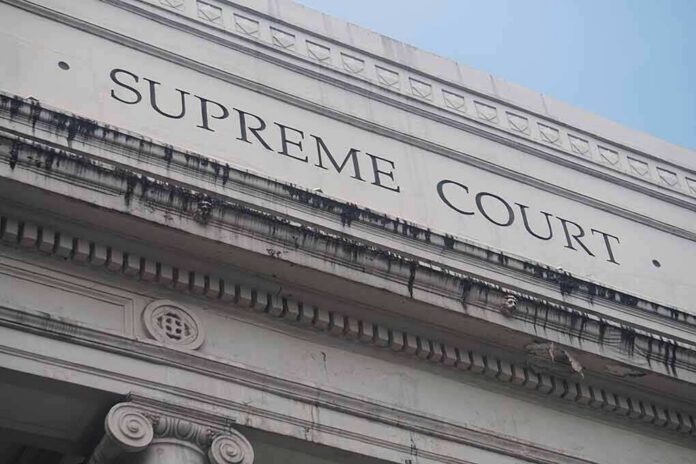
With the Supreme Court poised to rule on transgender athlete bans, women athletes are taking their fight over fairness and privacy from locker rooms to the nation’s highest court.
Story Snapshot
- The Supreme Court signaled support for state bans on transgender athletes in girls’ and women’s sports.
- Female college athletes sued the National Collegiate Athletic Association over fairness and privacy claims under Title IX.
- Advocacy groups argue inclusion has not harmed women’s sports and should remain protected.
- A federal brief shows legal battles now span courts, agencies, and statehouses nationwide.
What changed this week: a legal fight moves to a breaking point
Supreme Court justices heard arguments on state laws that bar transgender girls and women from female teams. Reporters at the hearing said the Court seemed likely to uphold the bans, which would reset rules across many schools and leagues. The cases arrive as more states pass similar measures. A win for the states would narrow who can play in the women’s category. The outcome would also guide school districts and athletic groups on how to enforce team eligibility.
A Congressional Research Service brief shows the conflict no longer lives only in school boards or sports bodies. It now includes federal enforcement, state laws, and private lawsuits from both sides. That spread raises the stakes for athletes and families. It also pressures national groups that set rules for colleges and youth sports. Whatever the Court decides will echo across these arenas and shape new lawsuits for years to come.
Why female athletes are speaking out: fairness, privacy, and Title IX
A group of current and former college women sued the National Collegiate Athletic Association in 2024. They argue policies that let transgender women into women’s events denied them equal chance to win, to earn awards, and to have private locker rooms. They bring their claims under Title IX, the civil rights law that bans sex discrimination in education. The case is ongoing. Their lawyers want clear sex-based categories and say the current rules let officials ignore biological differences.
These athletes say the issue is not about hate but about equal opportunity and safety in competition. They want the women’s category protected as its own space. They also argue that past policies forced them to share locker rooms in ways that felt invasive. Their filings claim missed medals, slower heats, and fewer roster slots for women under current rules. Their case reflects a broader push in states to legislate sex-based teams with clear criteria and enforcement.
The counter-case: inclusion, equal access, and limited impact claims
Advocacy groups respond that inclusive policies have not reduced fairness. The Center for American Progress says such rules help transgender youth and show no proven harm to competitive equity. The National Women’s Law Center has backed transgender athletes in court and argues there is no evidence they dominate women’s sports. Supporters frame the issue as one of civil rights. They say every student deserves a chance to play on a team that matches their gender identity.
Backers of inclusion also note that participation by transgender athletes remains small. They argue broad bans go far beyond any proven edge. They warn that strict sex testing or blanket rules can hurt girls who do not fit stereotypes. Nearly 200 athletes previously signed a statement urging equal opportunity for transgender girls and women, stressing inclusion as part of women’s sports progress. This view presses sports bodies to craft rules that avoid blanket exclusion while addressing safety.
What this means for schools, leagues, and families
Schools and athletic groups face hard choices while rules shift. A Supreme Court ruling that upholds bans would invite more state laws and tighter school policies. National bodies would need to align team eligibility, locker room access, and grievance processes. Families would need clear, simple rules that do not change season to season. Without consistency, athletes risk confusion, lost scholarships, and legal fights that drain time and budgets meant for practice and study.
A growing body of research maps the debate across science, law, media, and lived experience. A 2026 review in Frontiers in Sports and Active Living describes how these four frames shape public opinion and policy design. That helps explain why the same facts lead to different policy choices by different groups. When leaders skip clear standards, trust falls. Many Americans see this as another case where the system dodges hard calls, and regular people pay the price in chaos and conflict.
The bottom line: set bright lines, protect dignity, enforce the rules
Female athletes are telling courts and leaders they feel the system failed them on fairness and privacy. Inclusion advocates say broad bans are unfair and not backed by data on harm. The Supreme Court will likely force a clearer line soon. Whatever the outcome, officials owe athletes rules that are bright, simple, and enforced. If leaders stall or blur standards, both sides will keep losing faith that American institutions can solve tough problems for ordinary people.
Sources:
facebook.com, docs.legis.wisconsin.gov, tesi.luiss.it, williamsinstitute.law.ucla.edu, cbsnews.com, americanprogress.org, womenssportsfoundation.org